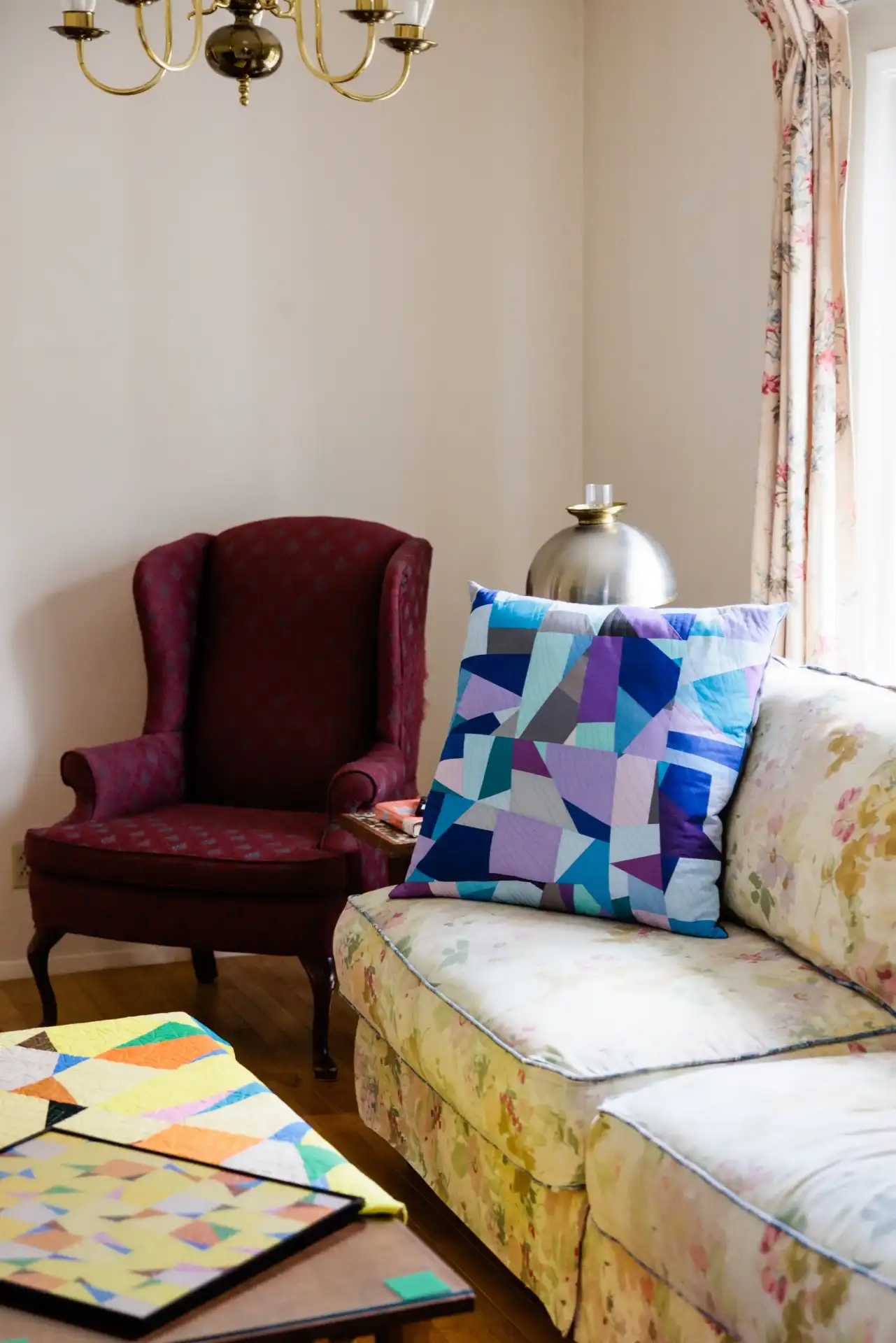
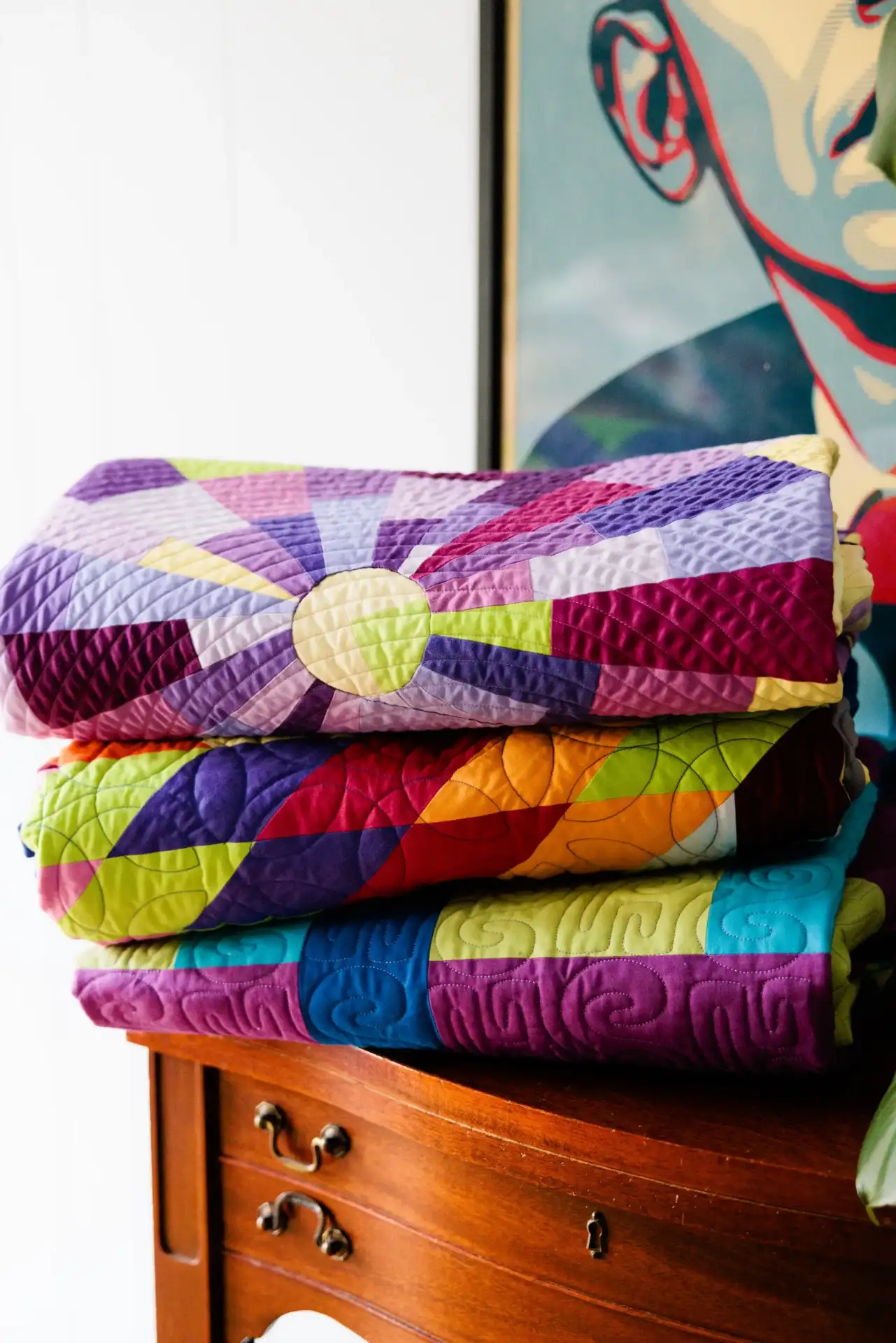
Since seventh grade, Angela Turner has been Angee with two “Es.” She changed the spelling to distinguish herself from the other Angies at her school. To say she does her own thing would be a correct statement about her.
Angee’s needle and thread journey began with sewing clothes. In preparation for her new teaching job, she created her work wardrobe during the summer after college graduation. “I sewed a dress, shirt, vest, or skirt every week,” Angee said. This generated a collection of fabric scraps.
As a young girl, Angee’s paternal grandmother mailed her a quilt every three to four years. “It was exciting to get mail,” Angee recalled. One particular Four Patch permanently resided on her bed, and about five years into teaching, during an unexpected two-day snowstorm, Angee decided it was time to re-create that quilt. “I had done multiple hand repairs on it, but after a while, it was beyond salvaging,” she said.
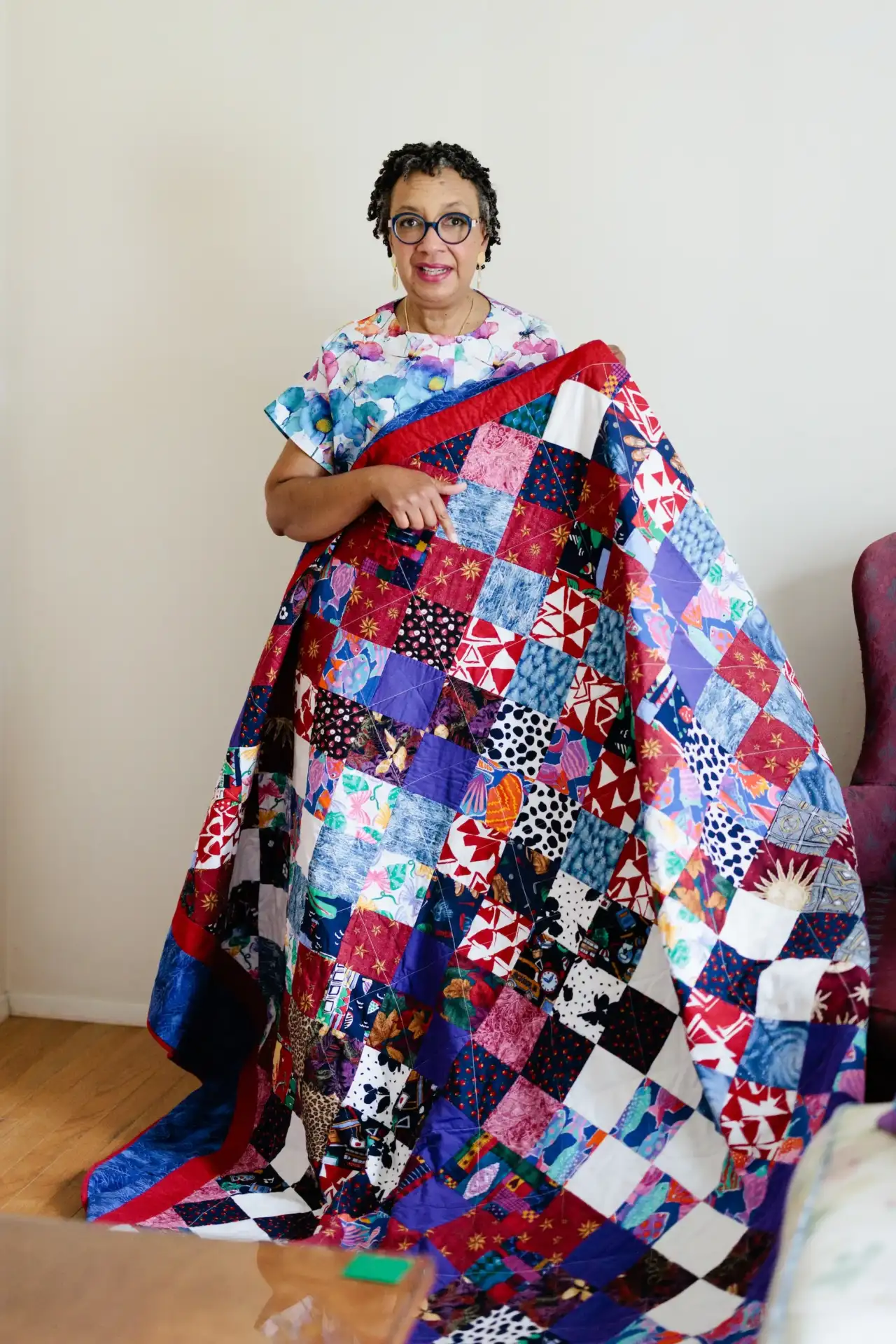
Armed with her garment sewing knowledge and her box of fabric scraps, Angee set to work cutting 4½-inch squares one day and sewing them all together the next. “I had a quilt top but no idea what to do next,” she said. “So I turned to the yellow pages of the phone book to find a quilt store.” Soon, she had borders and was machine quilting a king-size quilt on her domestic machine. She took it to school to show her students, and they enjoyed finding fabrics from her dresses, jackets, and vests. “I thought that was great. I still have that quilt,” she said.
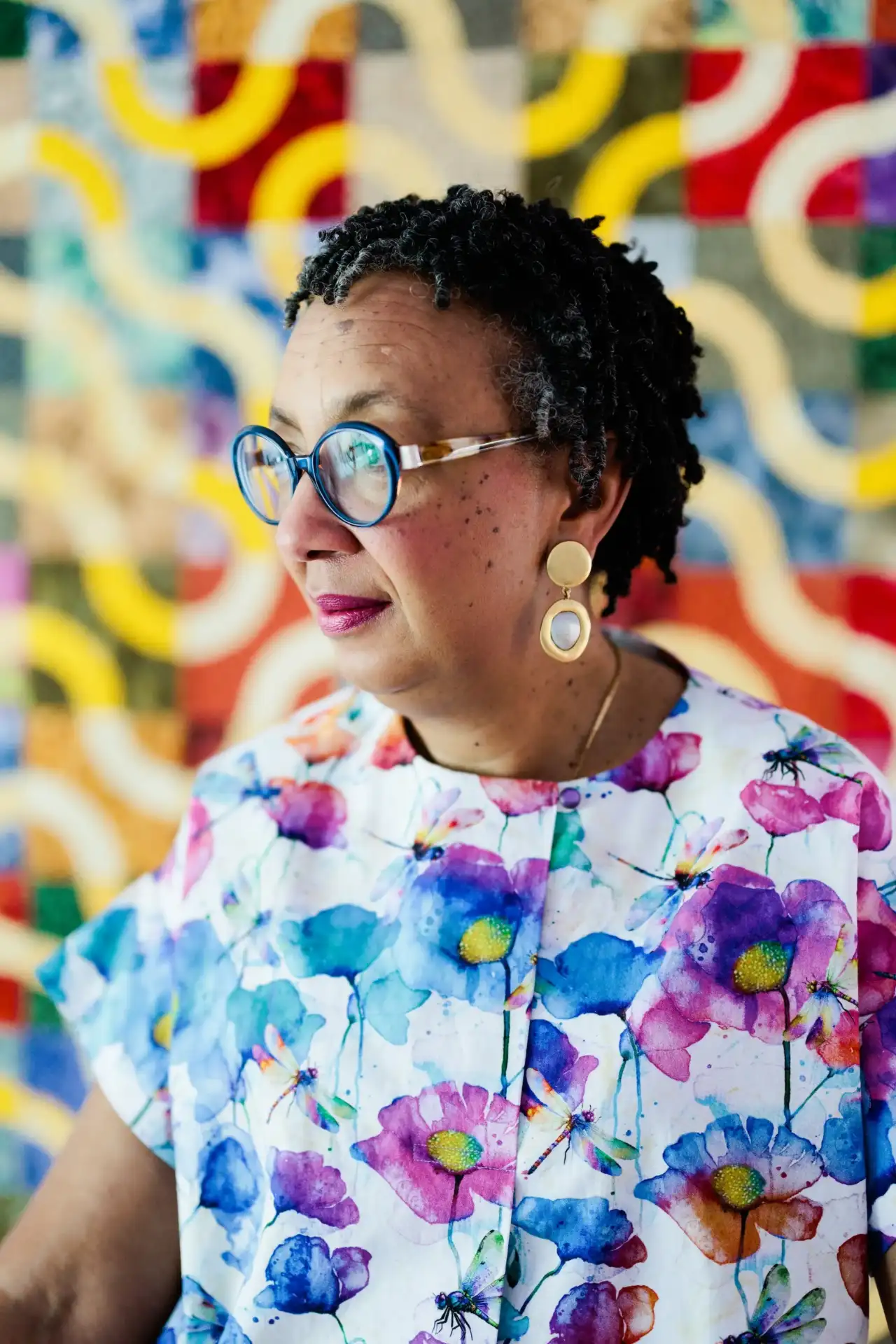
Angee Turner in front of her quilt "Follow the Yellow Brick Road (Less Traveled)."
That’s when Angee went down the quilting rabbit hole. She began as a traditional quilter because that was the only kind of quiltmaking she saw in real life and in library books. But after copying the patterns she found in those books, she got bored. “That’s when I found Liberated Quiltmaking by Gwen Marston. She taught me to use tradition as a foundation for my own imagination. I set the print fabrics to the side and began using bright solids as my palette. I experimented with minimalism but learned that maximal color saturation and patterns were my style,” Angee said.
She now describes her quilting style as contemporary, bright, and very graphic. “I haven’t let go of traditional quilting, but I like to shake it up—take a traditional block or pattern and give it a twist,” she said. And improvisational quilting has given her the ability to do that.
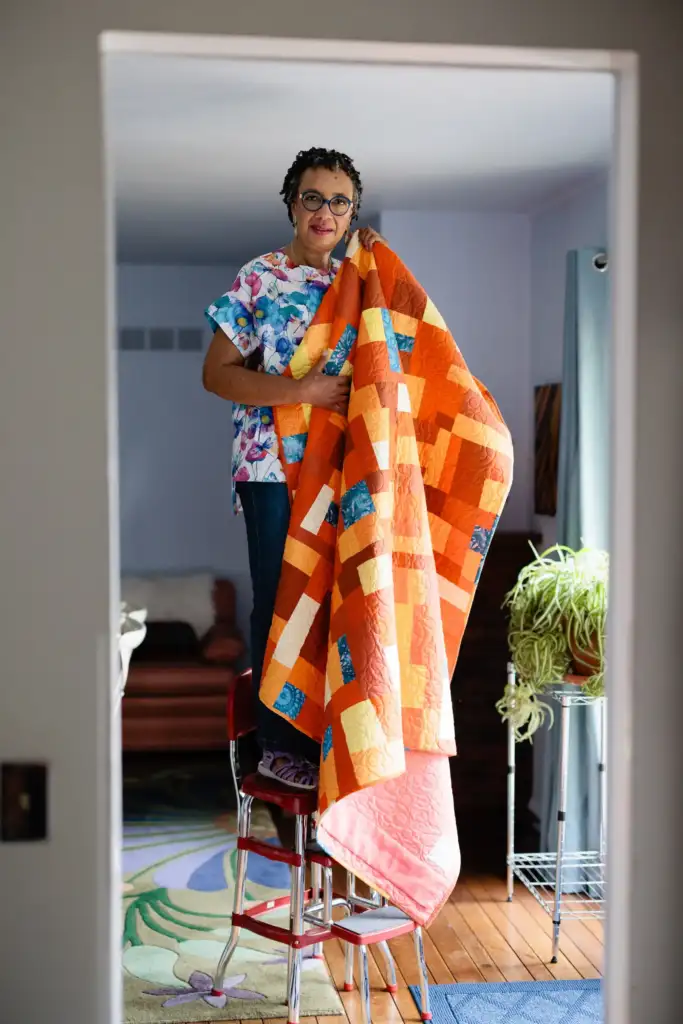
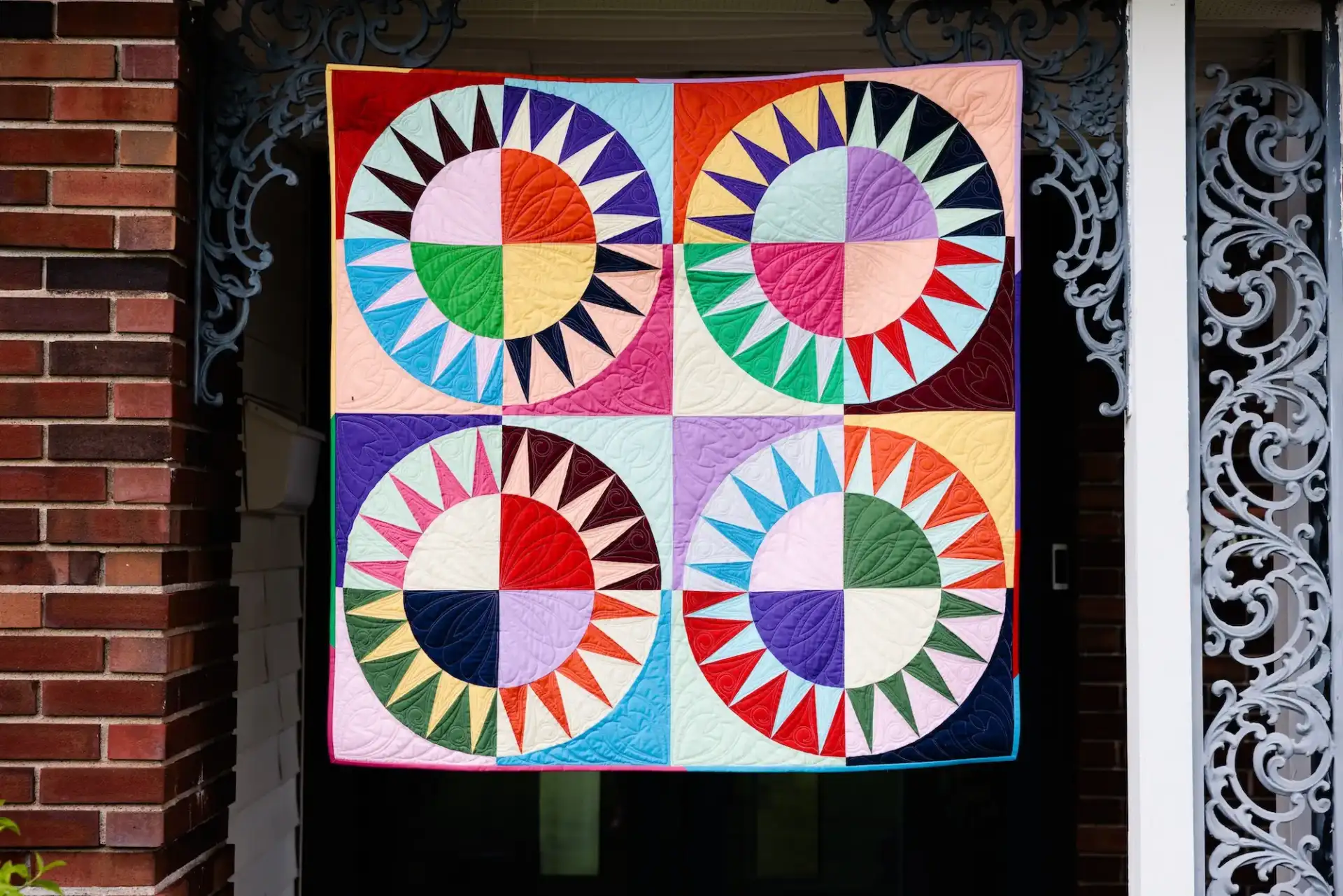
Angee Turner with her quilt "Orange Juice Blues" (2022), which was displayed at Lambert International Airport in St. Louis, Missouri, from 2022-2023.
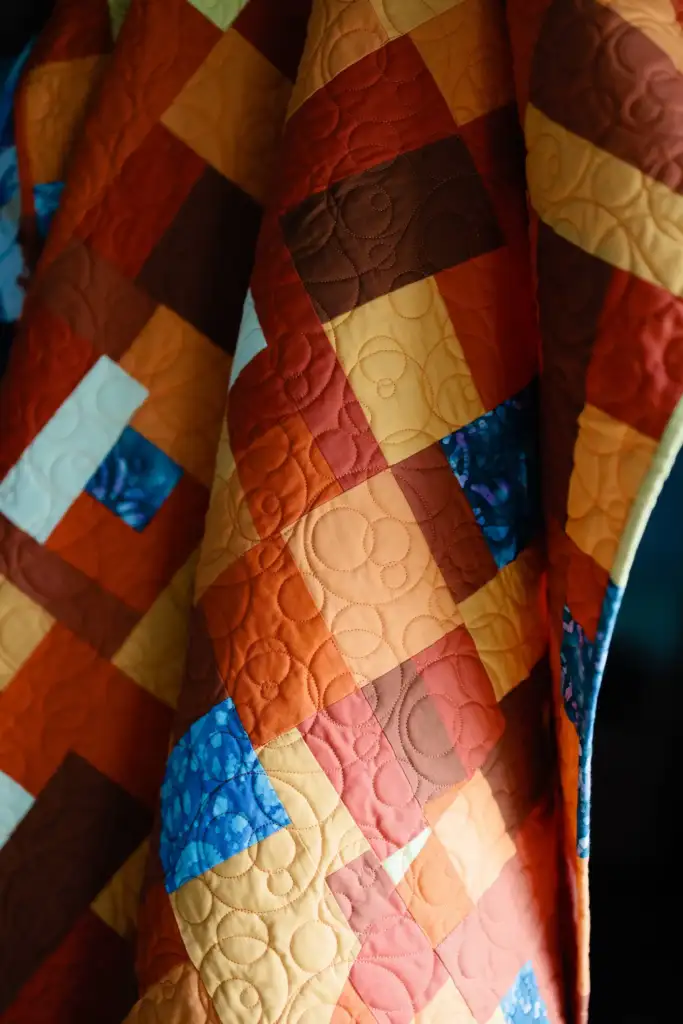
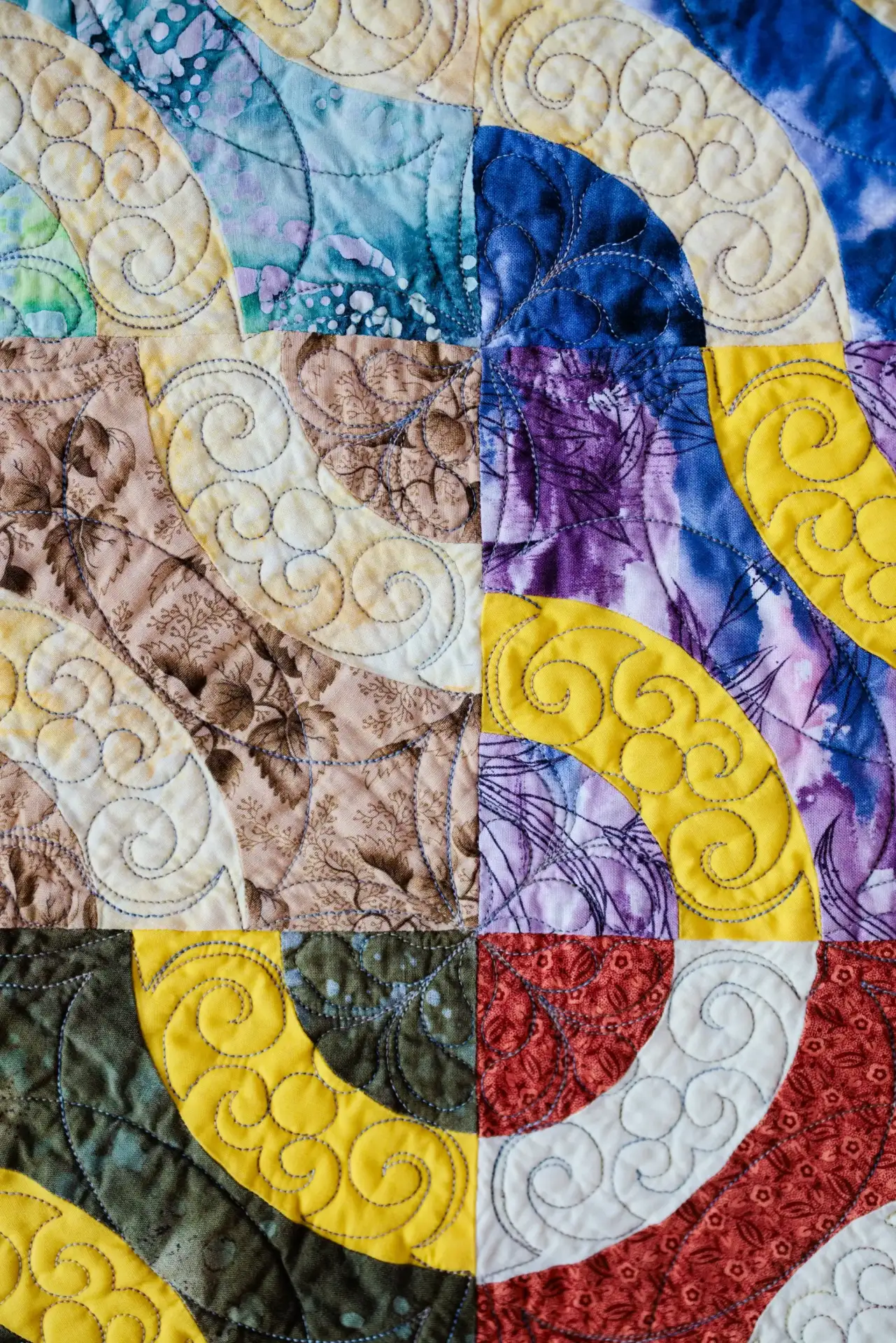
Detail of "Orange Juice Blues" (2022).
“Improv is often misunderstood. People think there are no rules, but good improv still has constraints and parameters,” Angee said. When teaching improv, she noted that the biggest hurdle her students encounter is where to begin, since there is no pattern. “My advice is to copy something, then splice the block and add color, use colors you don’t normally use, or try something wonky. With a pattern, you always know what to do next, but with improv, you are constantly making one decision after another. It can really upset a person,” she said.
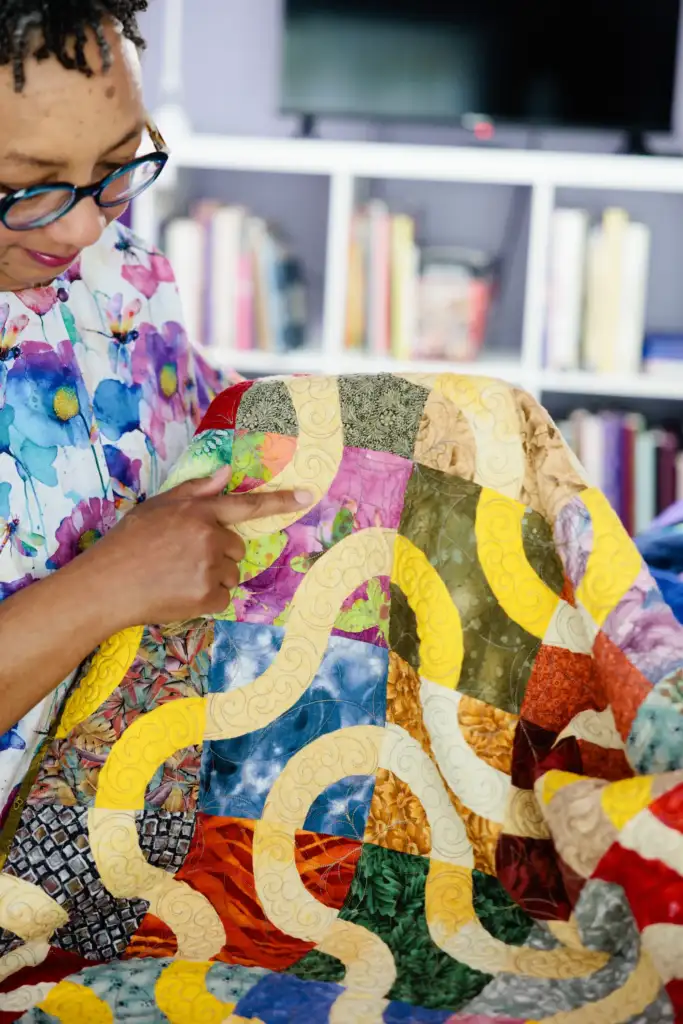
She loves the concept of puzzles, and in her own work, she likes to create sections, each of a different size, then piece something that might not look like it will go together. “I’ve embraced imperfection,” Angee said. “Perfection can be boring. I like the unexpected in a quilt. When something is a bit off, that attracts the viewer’s attention.” She is currently working with tiled blocks that she manipulates with turns, flips, and glides. She is also exploring the relationship between symmetry and asymmetry (with a book soon to follow).
Angee felt she really began to express her own creative voice following a 2004 trip to the mall and a chance meeting with men’s shirt designer, Ike Behar. A conversation ensued about his beautiful fabrics and their mutual love of quilts, which led to two very large boxes of cotton, silk, and linen scraps being delivered to her door. Angee designed a three-dimensional quilt block that looked like a men’s French cuff and created 50 unique cuff blocks for Ike’s 50th year business anniversary. Next, she searched for 50 unique cuff links. She asked strangers on the streets for cuff links. “If I saw a well-dressed man, I would stop, explain that I was an artist, and ask if he had cuff links. Sometimes, I would come home, and my doorman would have a bag of cuff links for me that some gentleman had dropped off,” Angee said.
Most of all, she hopes that her quilts speak joy to others. “I want people to feel joy and a sense of wonder and happiness,” she said. Ironically, she created some of her brightest quilts when she was feeling the lowest.
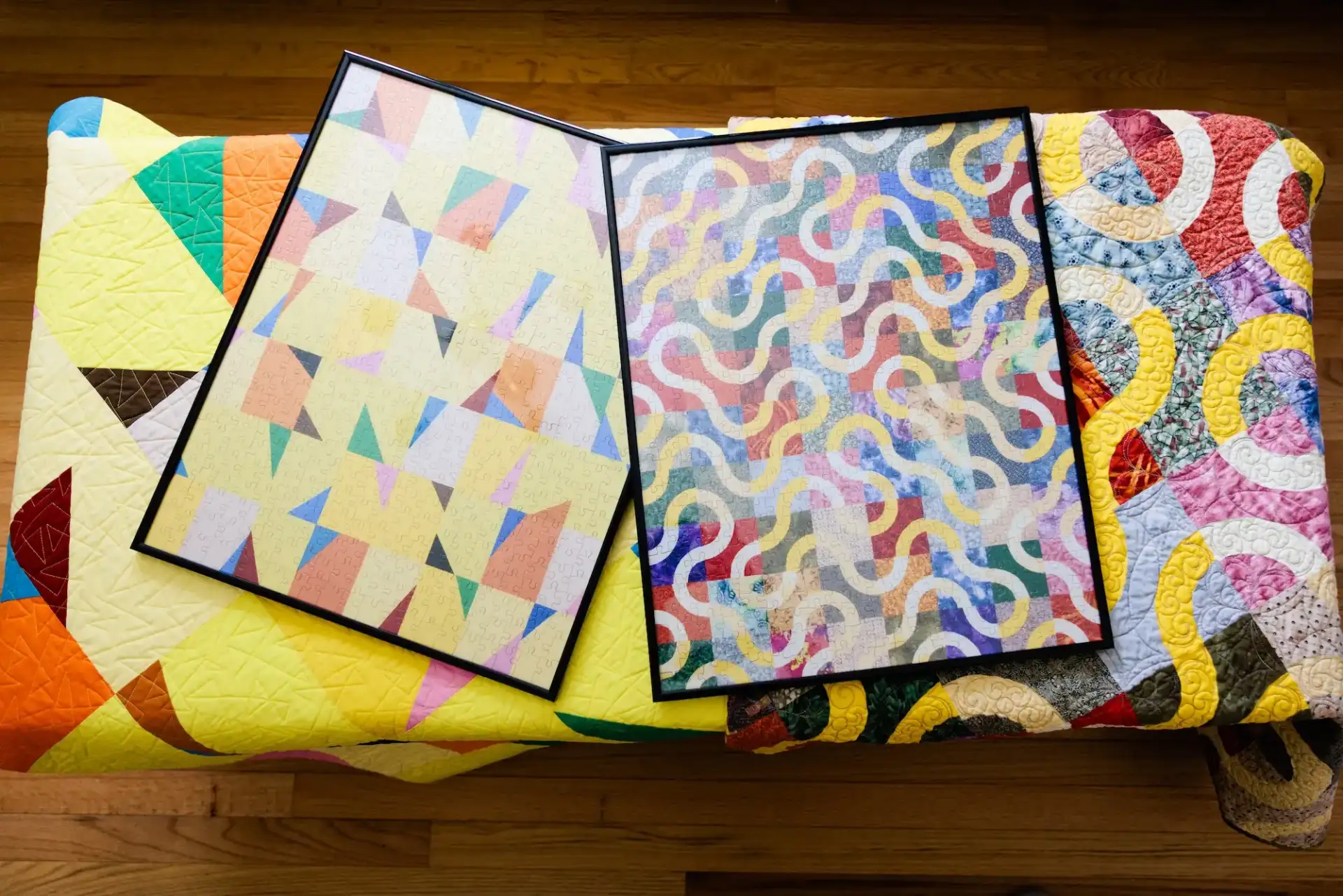
Pieced by Angee Turner and quilted by Jane Coons, "Follow the Yellow Brick Road (Less Traveled)" (2012) is available as a jigsaw puzzle sold on Angee's website.
However, with the help of her faith, she believes that whatever is not going well is temporary. She sees quilting as a metaphor for life. “You try to create a beautiful life from your different experiences, from the people you know, places you’ve been, your successes and failures. It’s similar to making a quilt: we each choose different fabrics with the same goal of making something beautiful,” Angee said.
Quilting has enriched Angee’s life. It has brought her joy and great friends. “I can’t imagine life without quilting. Quilters are the kindest people. I’m very proud to have inspired others and introduced them to this wonderful art,” she said.
Diane L. Murtha is an award-winning quilter, fiber artist, author, and international lecturer and instructor. Quilting for over 30 years, she gravitated to art quilts and discovered she loves challenges. Her quilts and articles are included in books, 30 + magazines, and multiple juried exhibits and international shows. Diane published her first book, Artful Insights in Fiber: Quilted Bits of Wit & Wisdom in March 2023. She currently resides in Iowa. Learn more at www.dianeLmurtha.com, or follow her on Instagram @dianelmurtha.
About the Photographer
Azuree Holloway has been photographing for Quiltfolk since 2019 and has contributed to many other projects. Check out more of her work on her website and her Instagram.