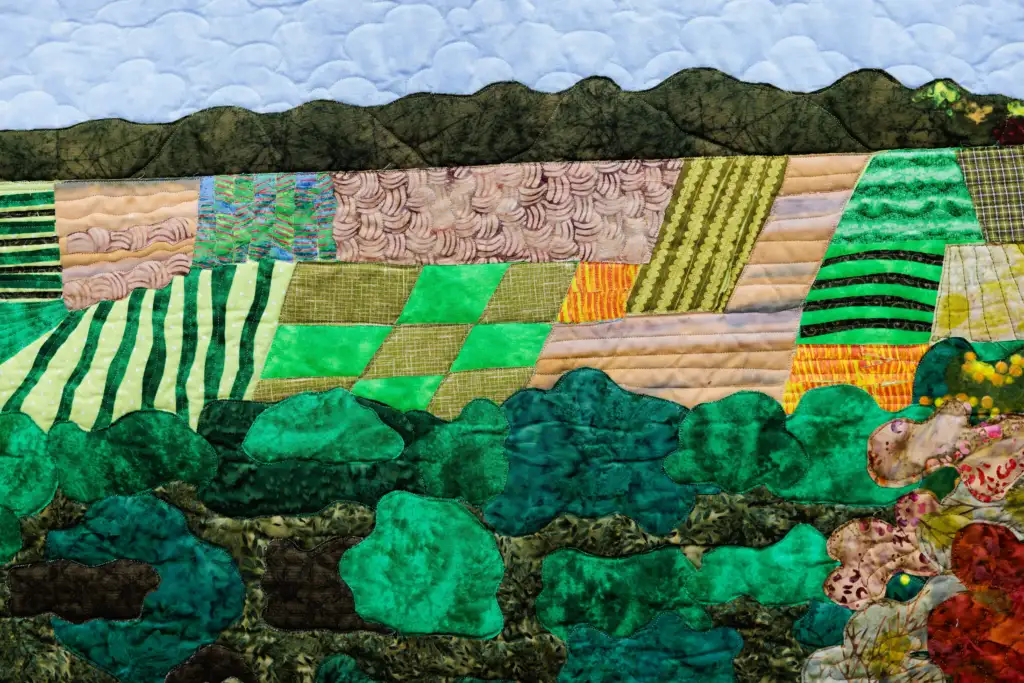
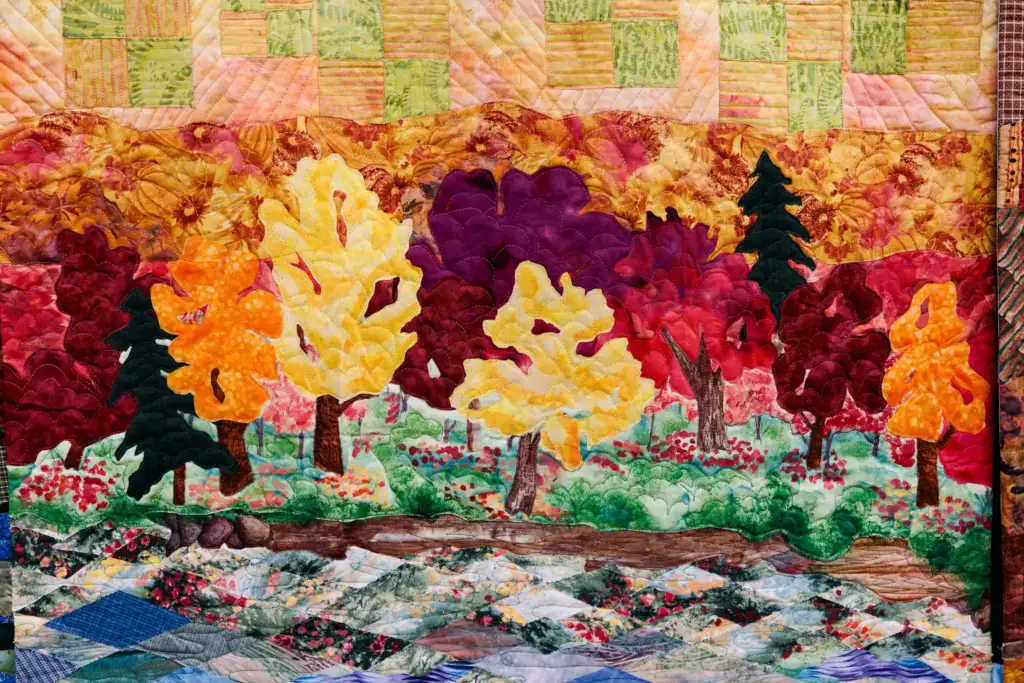
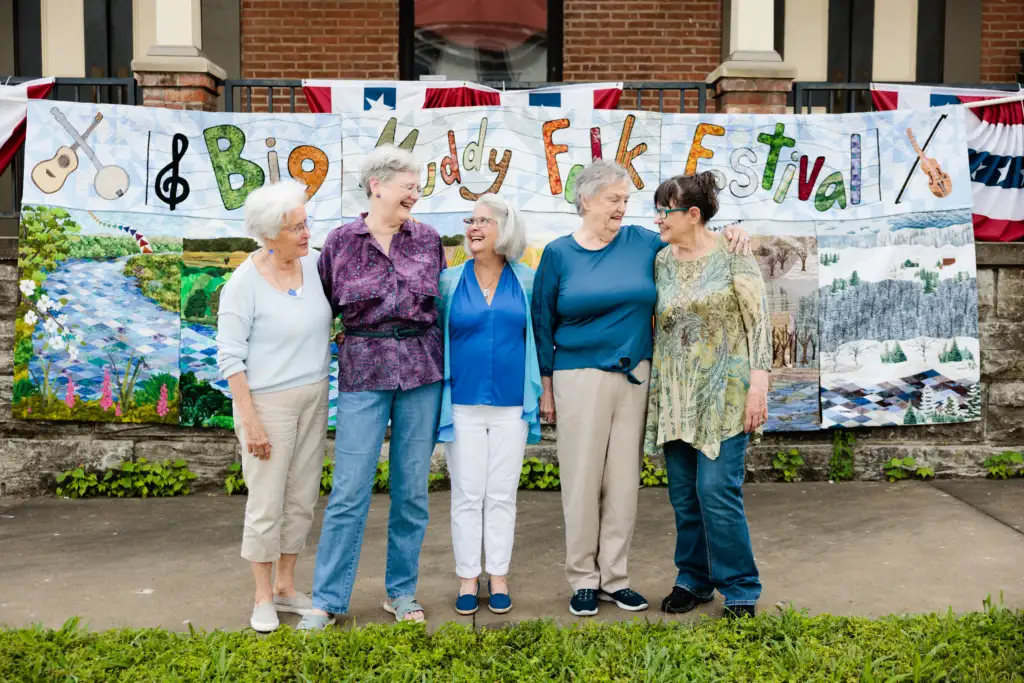
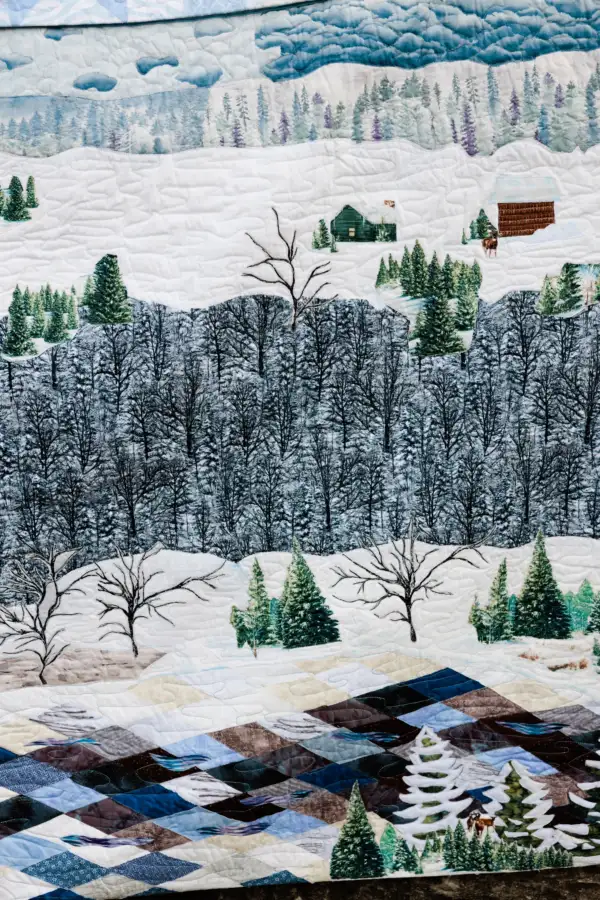
Missourians like to say the state has four seasons, sometimes all in one week. Six quilters, including Mona Stevenson, in Boonville made the case for six. Their quilt hangs as a banner behind the musicians at the annual Big Muddy Folk Festival: individual panels span 18 feet, depicting the Missouri River through the seasons.
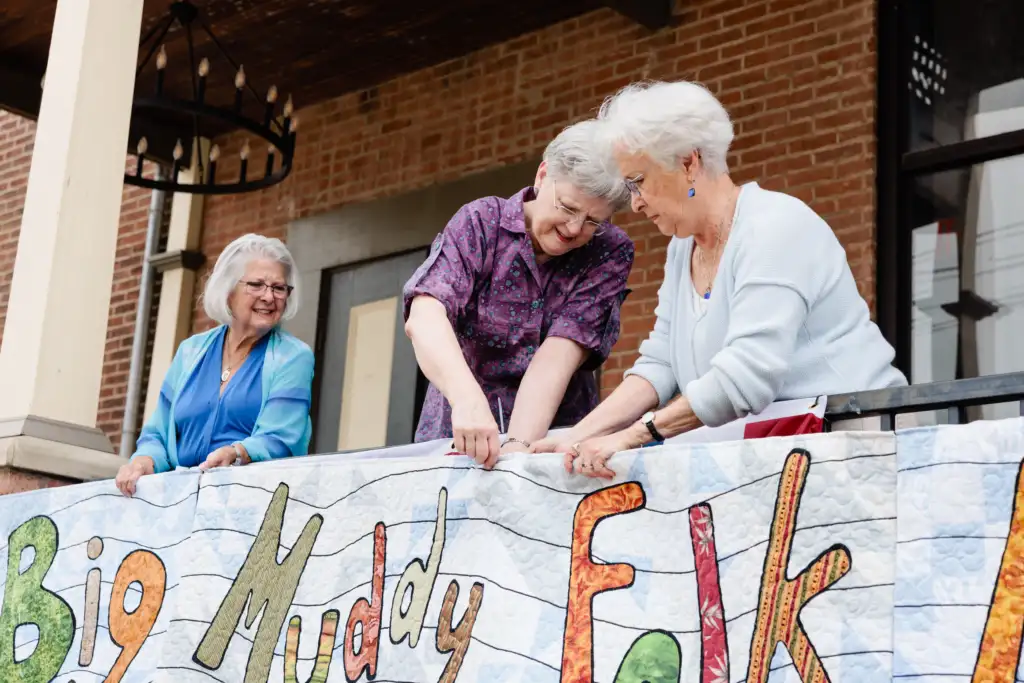
Contributors to the Big Muddy Folk Festival Banner: (L-R) Patti Cantu, Mona Stevenson, and Karon Huggler.
The friends Mona called on are art quilters, most of them from the Booneslick Trail Quilters’ Guild, and between them, they could do everything the banner would require. Christy Gray, who took summer, worked with cameras and photo editing software. Patti Cantu, who took early autumn, paints, draws, and shoots photographs. Janice Haralson, who took winter, started quilting in the early 1960s while she was teaching school. Suzanne Henage, who picked late spring, served as CEO of the guild, and Mona and Patti have both been presidents of it. Karon Huggler took early spring because she loves neon green and turquoise, and Mona took late autumn.
Patti won a ribbon at an American Quilter’s Society show in Des Moines, Iowa, and the International Quilt Festival in Houston, Texas, has shown her work—and that’s barely scratching the surface of what these quilters, who were all quilting by 1976, have accomplished.
“It was the bicentennial. Quilting was back in style,” Mona said.
Patti had great-grandmothers and great-aunts who quilted, so the craft had always been around her. “I actually never knew it was a lost art there for a few years,” she said.
In 2013, when the Big Muddy Folk Festival’s artistic director, Dave Para, asked Mona whether she might make something to decorate the stage, she knew what she was looking at. “I picked my jaw up off the floor, thinking about how big a project would have to be,” she said. “At the time, slice quilts were a thing. There are trends in quilting, like everything else. I’d been admiring them.”
Patti Cantu connecting two of the panels.
A slice quilt takes an image, enlarges it, and divides it into sections, each one interpreted separately before the sections come back together as the finished piece. Mona put out an invitation, and five people said yes. Each of them would be responsible for one panel, 3 feet by 4 feet, about the size of a crib quilt.
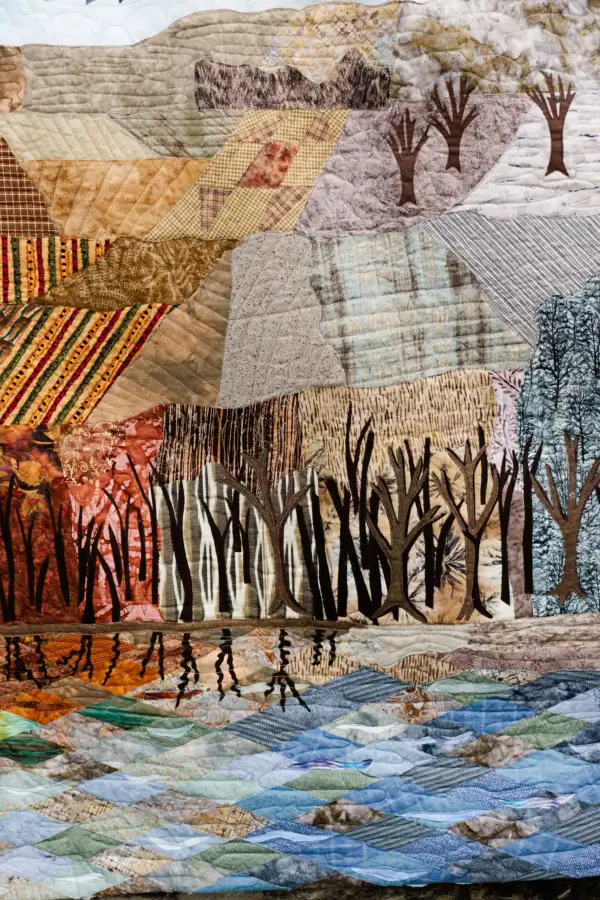
Late Fall panel made by Mona Stevenson.
Boonville sits on the Missouri River, which Missourians call the Big Muddy. Christy made a series of photographs from the overlook at Harley Park, looking toward New Franklin and the start of the Santa Fe Trail, and combined them into one long strip. She and Mona taped muslin to a wall in Christy’s sewing studio, projected a black-and-white version of the scene, and traced the river line and the skyline. Then they cut the tracing into sections and handed them out.
“We each pretty much first off chose what season we wanted to do, and as long as there wasn’t a conflict, we went with it. There weren’t any conflicts. We’re all laid back—pretty easy to get along with,” Patti said. “I particularly like color, and fall is my favorite season. So I chose fall. Mona also wanted to do fall. We needed an extra panel, so why not? I chose the high time in fall, and Mona chose after the peak.”
Mona said, “Mine’s mud season.”
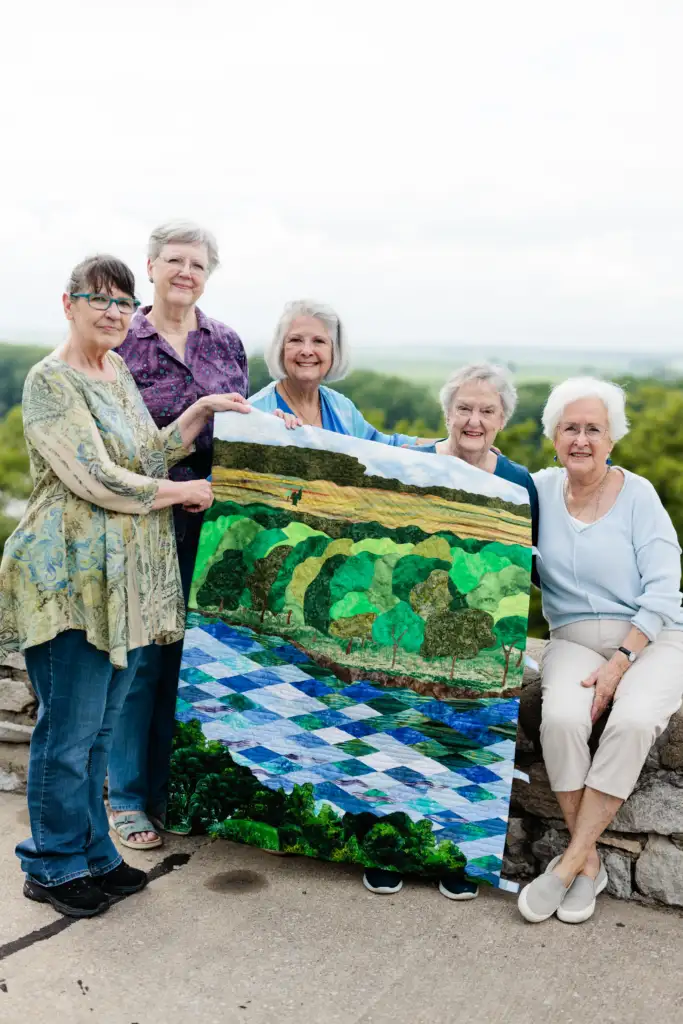
Holding the Late Spring panel: (L-R) Christy Gray, Mona Stevenson, Patti Cantu, Janice Haralson, and Karon Huggler.
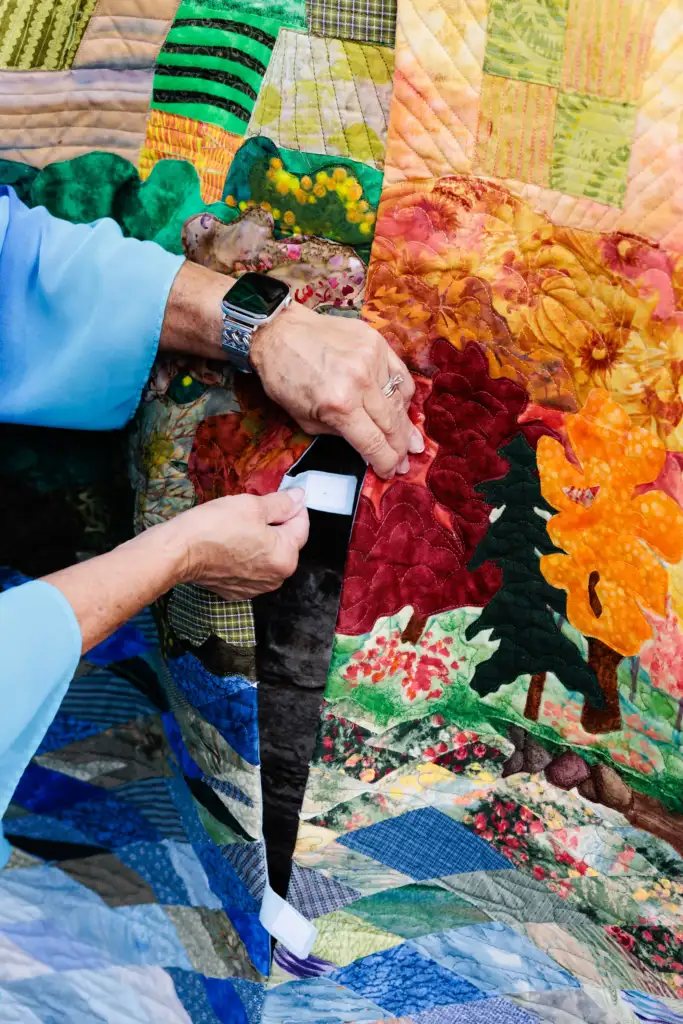
The quilters drew mostly from their stashes, and they worked traditional blocks into the scenery: Flying Geese, Hole in the Barn Door, Nine Patch, and Four Patch. For continuity across the panels, Karon suggested using diamond shapes for the water.
“That was Karon’s idea to use those diamonds, and it really makes the river look like it’s moving,” Mona said. “The river is actually much muddier than our colors, but, hey, we didn’t want brown in the spring. So we just used a variety of blues and greens. Then, for the winter panel, we used whites for the ice that’s on the river. So you get that progression of time.”
The winter whites gave the group pause. “I chose winter because of the fabric I had that was depicting winter,” Janice said. “I came in with lots of white, and the group—very carefully—told me that it needed to have some movement and not just be all white, like frozen, because that river has never hardly ever frozen over.
So we added some color to it, and it makes it look a lot more like it’s moving, even though there is ice in the river, which is very characteristic of the Missouri River during winter.”
The backing came from a friend of Mona’s, who had more donated fabric than she could use. “Bolts and bolts and bolts and bolts—like a truckload of bolts—of this heavy fabric that they use for making bags, and it’s all these different plaids,” Mona said. The weight helps the banner hang straight.
The Summer panel made by Christy Gray.
The Early Autumn panel made by Patti Cantu.
Standing in front of the fully assembled banner: (L-R) Karon Huggler, Mona Stevenson, Patti Cantu, Janice Haralson, and Christy Gray.
A snowstorm threw off the group’s schedule two weeks before the due date. “Is this going to be done? Is it going to look right? Is everything okay? Because all of us on that project are real diligent and precise about our quilting,” Patti said. “We were able to work around that. Being late March, [the storm] didn’t last a real long time. We just had to reschedule.”
The Winter panel made by Janice Haralson.
Mona said, “We had one big work session, and all of us were there, and we were putting on the facing. You’ll notice that there’s no binding on the panels. They’re all faced. So somebody was sewing on facings, and understitching, and tacking that down, and putting on the sleeves, and putting on the Velcro, and—I mean, we were just working like little demons in committees on different parts of it, trying to get it all done because we had a week left. That was getting down to the wire.”
The banner was displayed for the first time in 2014 and still hangs annually. “The first festival that it hung at was April 4th, and I remember that because not only did they introduce each of the artists on stage, but it was my birthday. So we had to go celebrate afterwards, too,” Patti said.
About the Author
Rebecca Bratburd joined the Quiltfolk team in 2023 and has written for the magazine and contributed to many other projects since. Learn more about Rebecca on her website and Instagram.
About The Photographer
Azuree Holloway has been photographing for Quiltfolk since 2019 and has contributed to many other projects. Check out more of her work on her website and her Instagram.